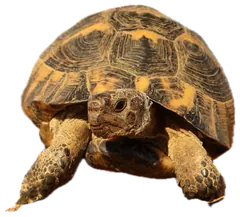
Tortoise: lifespan, size, diet and care
It can outlive you: 50 to 100 years. Indoors it needs a UVB lamp every day, because glass blocks UVB.
In the EU the three European tortoises (Testudo hermanni, graeca and marginata) are in Annex A of the wildlife trade rules: in Italy, buying or selling one, even as a swap, needs a certificate from the Carabinieri CITES units, plus a microchip and a declaration of possession.
Take the quiz: is it right for you?
How big it is
An adult has a shell up to 23 cm (9 in) long.
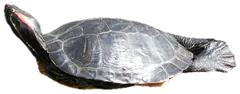
Zoomed ×8: here you see the man up to 23.8 cm (9 in) off the ground




Before it arrives
- An outdoor pen of at least 10 m² (108 sq ft) per tortoise, with a wall at least 45–50 cm (18–20 in) high and buried 10–15 cm (4–6 in), shade and a waterproof shelter in the sun
- An indoor enclosure of at least 180 × 120 cm (6 × 4 ft) for one tortoise, with soil and soft sand at least 5 cm (2 in) deep
- A basking lamp for a 35 °C (95 °F) spot and a UVB lamp less than 30 cm (12 in) away; the rest at 20–25 °C (68–77 °F) by day and 15 °C (59 °F) at night
- A timer: 12 hours of light in winter, 13 in spring and fall, 14 in summer
- A shallow water dish to drink and bathe in
- Pesticide-free wild weeds (dandelion, clover, plantain) and cuttlebone
- No gravel, wood shavings, alfalfa pellets, calcium sand or cat litter
- A reptile vet, who will also check it before brumation
Its home: temperature and light
- Basking spot
- 35 °C (95 °F)
- Cool side
- 20–25 °C (68–77 °F)
- At night
- 15–22 °C (59–72 °F)
- Humidity
- 30–50%
- Light
- 12–14 hours a day
- UVB lamp
- needed
What it eats and how often
wild weeds, flowers and grass; little supermarket produce
- Juveniles: every day
- Adults: every 2 days
Mostly pesticide-free wild weeds and flowers: dandelion, clover, plantain, chickweed, sow thistle, white dead-nettle. Very little fruit; no peas or green beans (too much protein), no cabbage, broccoli or spinach; no lettuce. Calcium: cuttlebone grated over the food; vitamin and mineral powder on the food 2–3 times a week (the RSPCA says a light sprinkle every day). Clean water at all times, in a shallow dish.
Vaccines and checkups
None: reptiles don't need vaccines.
A checkup at the vet every year. With a reptile vet.
The care calendar
What to do, from the most frequent to the least.
- every dayFresh waterClean water at all times, in a shallow dish it can also bathe in.
- every 2 daysGreens and weedsSuch as dandelion, clover and plantain. Young tortoises every day.
- every 3 daysCalcium and vitaminsAs a powder, on the food, 2–3 times a week; cuttlebone or calcium always available.
- every 2 weeksWeigh-inDuring brumation weigh it every 1 to 2 weeks: it should lose at most 1% of its weight a month. The rest of the year, keep a weight record.
- every 6 monthsUVB lampOn every day like natural daylight, less than 30 cm (12 in) from the tortoise: replace it when the brand says.
- every yearYearly check-upWith a reptile vet.
Call the vet right away if…
If you see one of these signs, call your vet now: don’t wait for it to pass.
- Bubbles or discharge from the nose, wheezing, or mucus around the mouth
- Hasn't eaten for a week while active (apart from the month before brumation)
- After brumation it doesn't start eating, seems not to see, or walks in circles
- During brumation it loses clearly more than 1% of its weight in a month, or passes urine
- Soft or misshapen shell, or blood in the droppings
Frequently asked questions
How long does a tortoise live?
Usually 50–100 years.
How big is a tortoise?
An adult has a shell up to 23 cm (9 in) long.
How much does a tortoise weigh?
We have no adult weight for this pet from a vet source: what matters is that its weight stays steady.
What does a tortoise eat, and how often?
Wild weeds, flowers and grass; little supermarket produce. Mostly pesticide-free wild weeds and flowers: dandelion, clover, plantain, chickweed, sow thistle, white dead-nettle. Very little fruit; no peas or green beans (too much protein), no cabbage, broccoli or spinach; no lettuce. Calcium: cuttlebone grated over the food; vitamin and mineral powder on the food 2–3 times a week (the RSPCA says a light sprinkle every day). Clean water at all times, in a shallow dish. Juveniles: every day; adults: every 2 days.
Does a tortoise need vaccines?
None: reptiles don't need vaccines.
When should a tortoise see a vet right away?
Right away if you see one of these signs: bubbles or discharge from the nose, wheezing, or mucus around the mouth; hasn't eaten for a week while active (apart from the month before brumation); after brumation it doesn't start eating, seems not to see, or walks in circles. The others are above, in “Call the vet right away if…”.
How old is a tortoise in human years?
There’s no serious human-years chart for a tortoise: the ones online don’t cite sources. What counts is where it is in its life: its senior years start at about 37.5 to 75 years old.
Tools for your tortoise
Always ask your vet: this site helps you understand, it doesn’t replace a checkup.
Sources
- RSPCA, Handle with care: Spur-thighed, Hermann's, marginated and Horsfield's tortoises (PDF) (checked on September 30, 2026)
- British Chelonia Group, Care sheet for Mediterranean tortoises (checked on September 30, 2026)
- Merck Veterinary Manual, Table: Important Husbandry Requirements for Selected Reptiles (checked on September 30, 2026)
- Italian Ministry of the Environment (MASE), guidelines on land tortoises (2019) and CITES note of 4 March 2026 (checked on October 13, 2026)
- Italian Ministry of the Environment (MASE), CITES note of 4 March 2026, and Regulation (EU) 2026/1383 (checked on October 13, 2026)
- Merck Veterinary Manual, Routine Health Care of Reptiles (checked on October 14, 2026)
- Association of Reptile and Amphibian Veterinarians (ARAV), Bearded Dragons, Companion Reptile Care Series (PDF, copy on a veterinary clinic website) (checked on October 13, 2026)
- Animal Diversity Web, Testudo hermanni (checked on October 13, 2026)
- British Chelonia Group, Hermann’s tortoise (checked on October 13, 2026)