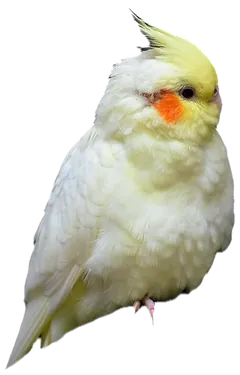
Cockatiel: lifespan, size, diet and care
It needs about 12 hours of darkness at night, in a quiet room.
Take the quiz: is it right for you?
How big it is
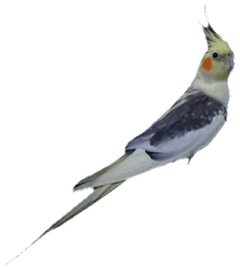
An adult is up to 35 cm (14 in) long.
Zoomed ×2: here you see the man up to 95 cm (37 in) off the ground



Before it arrives
- A companion of the same species: cockatiels live in flocks
- A cage at least 1.5 times its wingspan in height, width and depth (2 times if it stays inside most of the time); an aviary is better
- At least 6 hours a day out of the cage, in a safe room where it can fly: windows closed, fans off, never the kitchen
- Natural branch perches of different thicknesses; no sandpaper perches
- A bird UV lamp above the cage: window glass blocks UVB
- Cockatiel pellets, a few seeds, fresh vegetables; drinking water and a shallow dish for bathing
- Paper on the cage floor (not wood chips, corncob or cat litter) and a digital gram scale
- A home without cigarette smoke, air fresheners or overheated non-stick pans: the fumes can kill it
Its home: temperature and light
- The room
- 12–26 °C (54–79 °F)
- Light
- 12–14 hours a day
- UVB lamp
- needed
What it eats and how often
pellets and seeds, with fresh vegetables and fruit every day
- Adults: every day
Cockatiel pellets for 60–80% of what it eats, plus a few seeds every day (on pellets alone they can get kidney problems). The rest fresh vegetables (peas, broccoli, kale, carrot): fruit and veg no more than a quarter of the diet. Never avocado, chocolate, caffeine, alcohol or salty food.
Vaccines and checkups
Usually none: there are a few bird vaccines, but most pet birds don't get vaccinated. Ask your vet.
A checkup at the vet every year. Once a year, with an avian vet.
The care calendar
What to do, from the most frequent to the least.
- every dayFresh food and waterWash the bowls and water bottle every day with hot, soapy water (rinsing isn't enough) and change the water.
- every dayCage paperChange the cage paper every day: that way you can see how many droppings there are and their color.
- every weekWeigh-inUse a digital gram scale and note the weight: if it changes by more than 10%, see the vet.
- every weekFull clean of the cageAt least once a week, with a bird-safe disinfectant.
- every weekBath timeOnce or twice a week, even in winter: a shallow dish of water or a mister.
- every 6 monthsUVB lampThe bulb keeps giving light even after its UVB is gone: replace it after 6 to 12 months, as the brand says.
- every yearCheck-upOnce a year, with an avian vet.
Call the vet right away if…
If you see one of these signs, call your vet now: don’t wait for it to pass.
- Sits fluffed up and sleeps more than usual with its eyes closed
- Its tail bobs with each breath, or you hear wheezing
- Sits low on the perch or on the cage floor
- Has lost more than 10% of its weight
- Eats or drinks much more or less than usual, or its droppings change
Frequently asked questions
How long does a cockatiel live?
Usually 10–20 years.
How big is a cockatiel?
An adult is up to 35 cm (14 in) long.
How much does a cockatiel weigh?
An adult weighs 50 to 100 g, 1.8–3.5 oz (the RSPCA weight class).
What does a cockatiel eat, and how often?
Pellets and seeds, with fresh vegetables and fruit every day. Cockatiel pellets for 60–80% of what it eats, plus a few seeds every day (on pellets alone they can get kidney problems). The rest fresh vegetables (peas, broccoli, kale, carrot): fruit and veg no more than a quarter of the diet. Never avocado, chocolate, caffeine, alcohol or salty food. Adults: every day.
Does a cockatiel need vaccines?
Usually none: there are a few bird vaccines, but most pet birds don't get vaccinated. Ask your vet.
When should a cockatiel see a vet right away?
Right away if you see one of these signs: sits fluffed up and sleeps more than usual with its eyes closed; its tail bobs with each breath, or you hear wheezing; sits low on the perch or on the cage floor. The others are above, in “Call the vet right away if…”.
How old is a cockatiel in human years?
There’s no serious human-years chart for a cockatiel: the ones online don’t cite sources. What counts is where it is in its life: its senior years start at about 7.5 to 15 years old.
Tools for your cockatiel
Always ask your vet: this site helps you understand, it doesn’t replace a checkup.
Sources
- RSPCA, Pet birds: environment (checked on September 30, 2026)
- Merck Veterinary Manual, Table: Popular Pet Birds (checked on September 30, 2026)
- Association of Avian Veterinarians, Basic Care for Companion Birds (PDF) (checked on October 13, 2026)
- Merck Veterinary Manual, Feeding a Pet Bird (checked on October 13, 2026)
- Royal Veterinary College, Cockatiel care (2022, PDF) (checked on October 14, 2026)
- Merck Veterinary Manual, Importance of Veterinary Care in Pet Birds (checked on October 13, 2026)
- Association of Avian Veterinarians, Signs of Illness in Companion Birds (PDF) (checked on October 13, 2026)
- Association of Avian Veterinarians, Ultraviolet Light as a Critical Component of Companion Bird Husbandry (PDF, 2024) (checked on October 13, 2026)
- Merck Veterinary Manual, Signs of Illness in Pet Birds (checked on October 13, 2026)
- Royal Veterinary College, Budgerigar care (2024, PDF) (checked on October 14, 2026)
- Merck Veterinary Manual, Providing a Home for a Bird (checked on October 13, 2026)
- Animal Diversity Web, Nymphicus hollandicus (checked on October 13, 2026)